
Dream Blog
Read about Dream Tank news and recent events,
watch archived content, and more!
The Biometrics of Peace
That morning, In Truth launched the Biometric Peace Index, the first measure of peace from the inside. That afternoon, a Systems Change L.A.B. gave the people it measures a say in what it becomes.
By Heidi Cuppari, Founder of Dream Tank. Dream Tank and the PEAC Institute designed and facilitated this Co-Design Workshop through the Systems Change L.A.B.
On August 8, In Truth’s Global Peace Activation brought 131 communities together for a synchronized meditation. People wore the devices they already owned and journaled how they felt. Heart rates dropped by about 10 BPM. Pleasant feelings rose from 55% to around 83%. The new Index went from roughly 50 to 80.
A number only matters if it changes decisions. So after the press conference, the question went to the room: if our systems were designed around what people tell us creates peace, what would become possible? To answer it, we used the Systems Change L.A.B. arc, the same four stages young people in Colorado use to take on problems in their own cities.
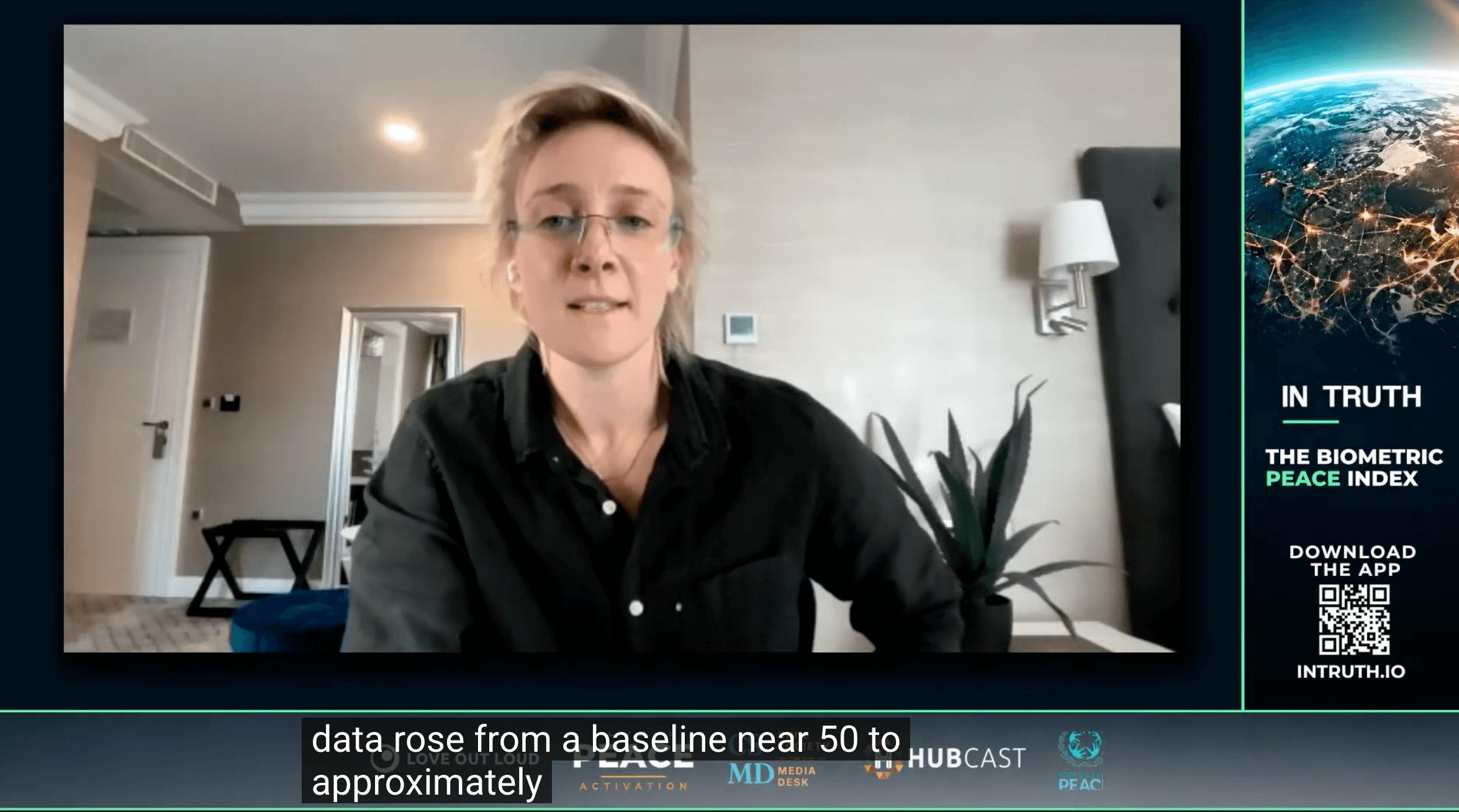
“The world has spent a long time counting what breaks us, but today we start counting what holds us together.”
Nicole Gibson, Founder, In Truth
One room, not an audience
People joined in person in New York and on Zoom from Brazil, across the U.S. and beyond: filmmakers, occupational therapists, community mentors and In Truth’s own science team. Every block had an online task, and no one online went more than fifteen minutes without being asked to contribute.
How the four hours worked
The Systems Change L.A.B. arc, run as one hybrid room in New York and online.
Heal
The workshop opened with a bowl, a breath and a bell. Each person silently named one thing they love enough to protect, and carried it as their compass for the afternoon. Then the room listened to the August 8 data, and before any adult analysis, it heard the youngest voice first: a line read word for word from a Boulder child’s peace map.
Dream
Eyes closed, sixty seconds: It is September 22, 2036. The Peace Index has been guiding decisions for a decade. Walk through your neighborhood. Each group came back with three possibilities and one question.
Build
The questions got practical fast. How do you measure 17,000 kids at a Football for Peace event affordably? What can a festival or concert teach a research study? How could intergenerational mentorship and home kits for mothers strengthen a community’s signal? One idea took hold in both rooms: a global youth hackathon asking young people how they would design the Index.
Launch
The close was a harvest, not a debate: questions to explore, ideas to test, research areas, questions to take back to communities, and ways to keep co-designing. Each person finished one sentence, “What I carry back to my community is…”, and then everyone, in the room and online, took one shared breath with the biometrics running.
“The beginnings of a dream come true on a very deep level.”
Nicole Gibson, at the close of the day
Why this matters
The Systems Change L.A.B. starts from one idea: the people closest to a problem should help design the solution. In Golden, that means a nine-year-old’s question about sharing the street becoming a Mines capstone. At the Peace Index, it meant the communities who offered their heartbeats helping decide how that data is used. Everything the room surfaced belongs to the Peace Index initiative and goes back to the communities that offered it.
A follow-up working session is now pulling together what the room surfaced, to shape the next version of the Index.
Want to run a Systems Change L.A.B. with your community, company or city? Write to heidi@dreamtank.co.
The Biometric Peace Index and the August 8 dataset belong to In Truth and its partners. The co-design workshop was facilitated by Dream Tank and PEAC Institute through the Systems Change L.A.B., with broadcast by Hubcast.
Dream Tank is a Colorado nonprofit that has worked with 10,000+ young people, incubated 80+ youth ventures, and helped shape three Colorado laws. The Systems Change L.A.B. is co-created with the PEAC Institute.
A nine-year-old asked how we share the street. Nine Mines seniors chose it as their capstone.
Golden, Colorado · September 2026
A nine-year-old asked how we share the street. Nine Mines seniors chose it as their capstone.
In August, a room of nine- to eighty-year-olds in Golden asked how we all share the same street safely. Thirty-four days later, nine Colorado School of Mines seniors signed on to spend their final year answering it — for Golden, and for every city that comes next.
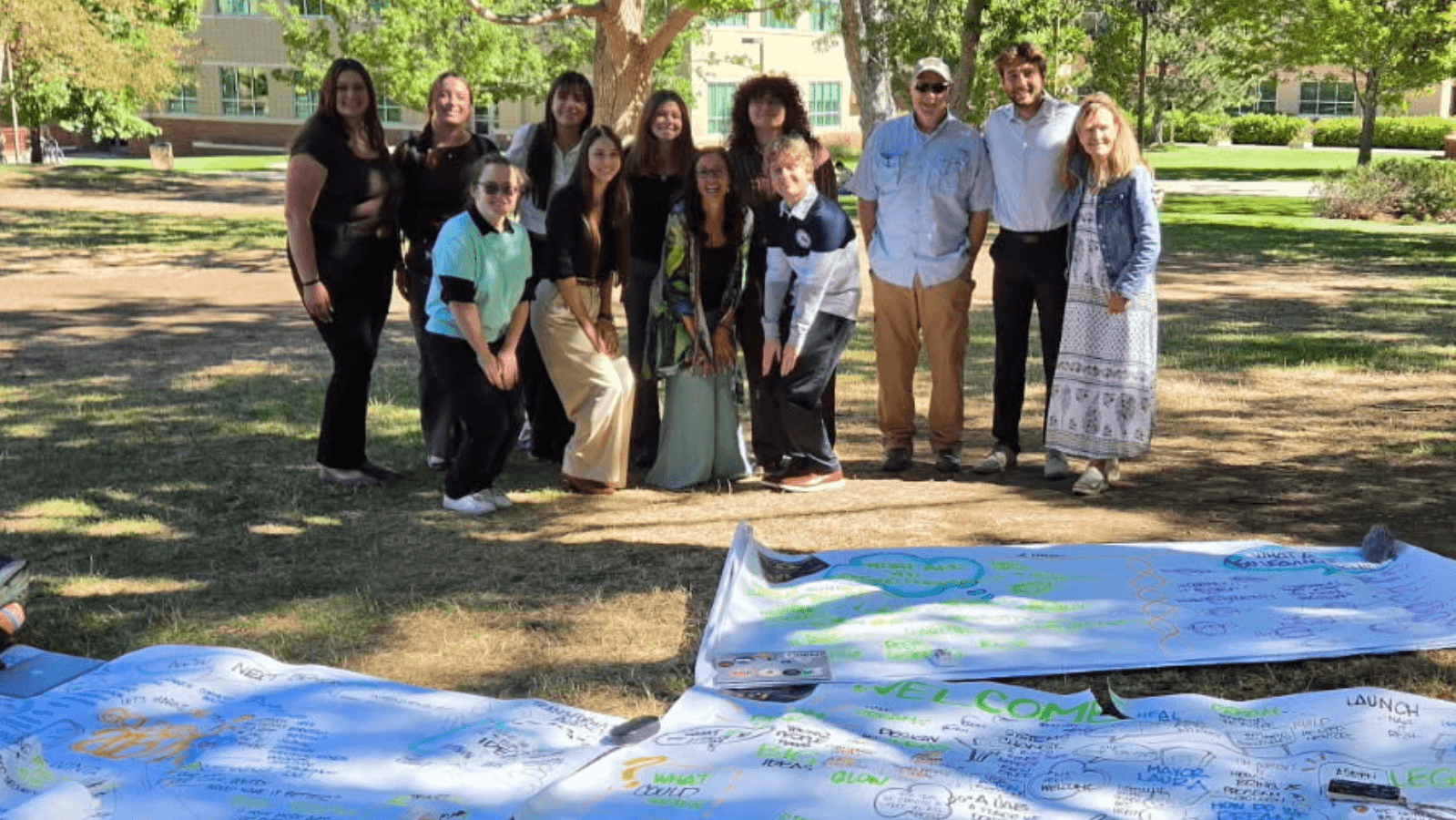
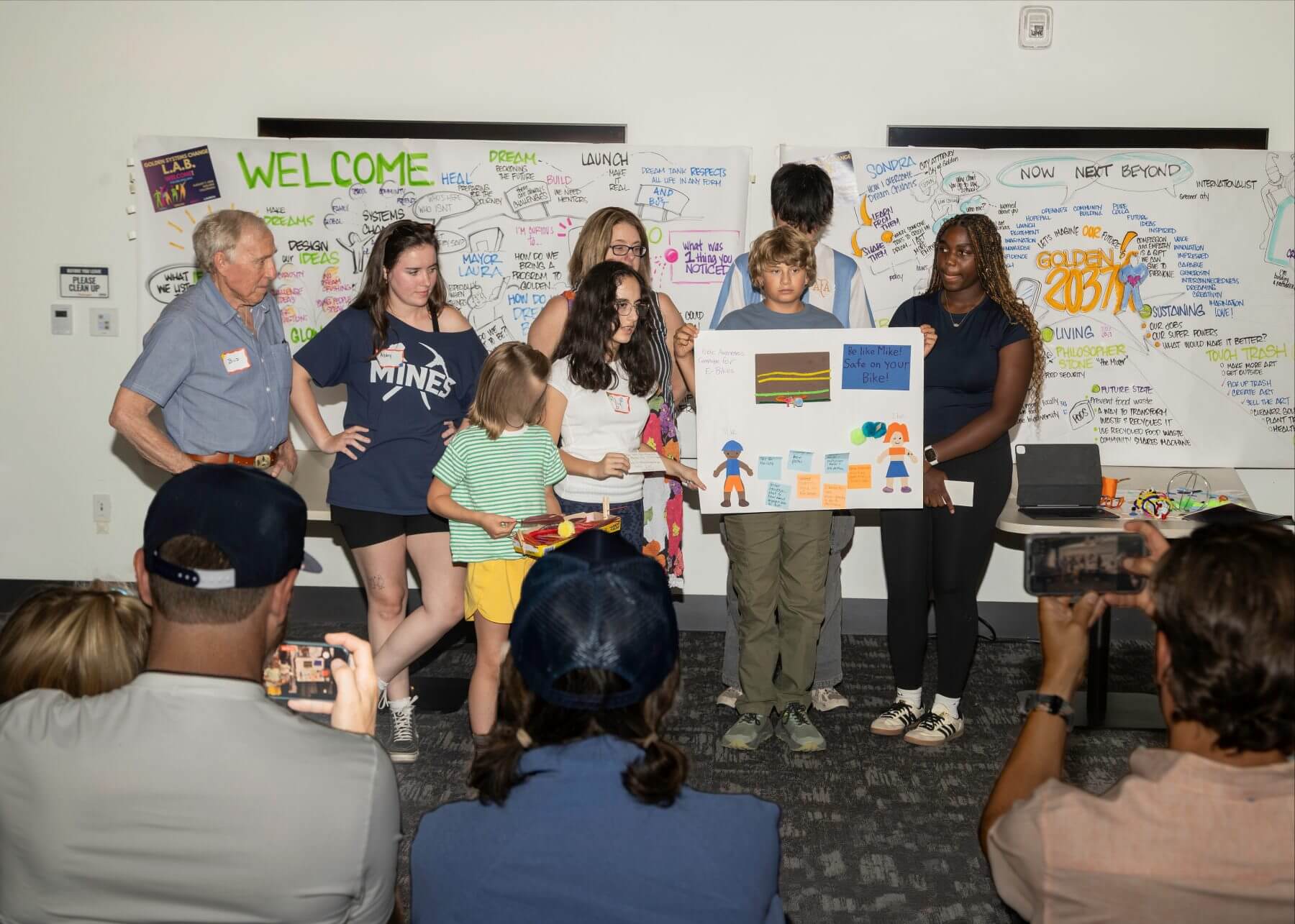
On August 7, nearly forty people between the ages of 9 and 80 spent a full day at Colorado School of Mines working on Golden’s problems together. Design pods — each holding two elementary students, a high schooler, a college fellow, and a Dream Tank alum — worked alongside community mentors, engineers, civic leaders, and elders. The mayor gave the entire day. Two intergenerational teams each presented a different approach to the same challenge: how people on foot, on bikes, and on e-bikes share the same right of way without hurting each other.
Nobody wanted that to end with a poster on a wall.
On September 10, it didn’t. A senior capstone team at Mines kicked off with the Systems Change L.A.B. as its client, a signed sponsor agreement, and nine months to work. Nine college seniors. Five engineering disciplines. One problem a nine-year-old put on the table.
“Community input must directly inform engineering decisions.”
From the team’s own project requirements, written before the first listening session
The problem, as the team wrote it
Golden’s streets, crossings, and shared-use paths carry many modes of travel with no effective way for the people using them to detect one another and avoid conflict. The goal is a practical, tested solution that makes those shared paths safer for everyone. The specific site, the specific conflict, and the final solution are all still open — deliberately. Those answers are supposed to come from the community, not from a conference room.
Two deliverables, on purpose
01 · A real solution
Something Golden can actually act on: designed, prototyped, and tested with the people who use the right of way every day, to a standard a professional engineer would stamp.
02 · A replicable model
A community-sourced engineering template the next city can pick up and run. This cohort is the first to prove it works — and the published model carries their names.
Meet the fellows — the Dream Team
They named themselves. Six of them found this project at the senior design expo and chose it. Here they are, in their own words.
“I’m particularly passionate about creating spaces that bring people together and feel heard. I love seeing change enacted, and being a part of this project is an honor.”
Communication lead
“I loved building something that served the traveling public by keeping them safe. This project is the perfect continuation of my interests — working with, and for, my community.”
“My favorite part of the industry is building infrastructure that serves the community and creates a lasting impact. I’ve trained for my first marathon on Golden’s trails — I know how people use them.”
“Two years mentoring high schoolers in FIRST Robotics showed me the importance of creating spaces where young people feel heard and empowered to contribute.”
“Pedestrian safety in Golden, especially for youth, caught my eye when I moved here in 2023. When I found out I could address it through senior design, I knew it was the one.”
“I’ve spent a lot of time outside my whole life. A system that keeps our community safe while people are out in it — I knew I wanted to be part of that.”
“Roadway design pulled me toward transportation. I love hearing different stories, which makes me excited for a community-focused project — for Golden and places like it.”
“Growing up in a small town, I worked closely with my city leaders and saw how infrastructure directly impacts the people who live there. Transportation shapes accessibility and quality of life.”
“I fear for people I know, and for myself, with the way all the modes of traffic mix on our streets and sidewalks. Making plans for the community, with the community — that sold me.”
Nine months, four gates
Why this one is different
A city of 20,000 is functioning as the incubator. The mayor assigned city engineering support to student-led work. Nine-year-olds set the agenda in August and will sit in the listening sessions this fall. The young people follow the Dream Tank Method — HEAL, DREAM, BUILD, LAUNCH — alongside their Mines process, and the pre-work that framed their first week came from the Epiphany Lab, adapted with permission from Janine Underhill, Visual Futurist.
Every two weeks for nine months, the client and the team meet for thirty minutes. When they need an expert — a rail engineer, a bike-industry veteran, a city planner — they name the person and we open the door. That is the model we are trying to make repeatable.
Who made this possible
The Mines program is community-funded by design — a blend of philanthropy and civic investment that keeps the work locally rooted. The Johnston Education Fund (an impact innovation ecosystem funder), the City of Golden, Colorado School of Mines, the Golden Civic Foundation, Bob’s Atomic Burgers, and the Colorado Gives Foundation each backed it. The City of Golden gave staff time and the mayor’s full day; PEAC Institute co-created the Systems Change L.A.B. Mark Bowman advises the team from the Mines side; Pete Turner and JJ Trout mentor from the community side.
What happens next
Listening sessions open this fall in Golden — residents, riders, walkers, drivers, city staff, and the young people who started this. If you live, ride, or work in Golden and want to be in the room, or if you have expertise this team should borrow, write to heidi@dreamtank.co.
A problem named by a nine-year-old, engineered by nine young adults, and adopted by a city. This is what youth-powered systems change looks like when it’s built to last — and you can help carry it to the next city.
Championed by Mayor Laura Weinberg and the community members of Golden, Colorado.
Dream Tank is a Colorado nonprofit that has worked with 10,000+ young people, incubated 80+ youth ventures, and helped shape three Colorado laws. The Systems Change L.A.B. is co-created with the PEAC Institute.
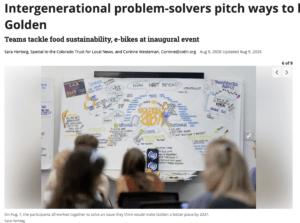
In the Golden Transcript: Intergenerational problem-solvers pitch ways to help Golden

Young People Will Pitch the Future of Golden at Systems Change L.A.B. Community Showcase
Golden’s founding pilot program demonstrates a new model for civic participation by bringing youth voices into community problem-solving from the very beginning.
GOLDEN, Colo. – Communities often ask young people what they think after decisions have already been made. The Golden Systems Change L.A.B. flips that model by inviting youth to help design solutions from the start.
On Friday, Aug. 7, 2026, from 5:30 to 7 p.m., community members, civic leaders, educators, and media are invited to attend the Systems Change L.A.B. Youth Pitch Night hosted in partnership with the Colorado School of Mines,, where up to 24 young people will present their ideas for strengthening community wellness in Golden. Event RSVP: https://luma.com/jxazh5sq ·
The event showcases an innovative approach to strengthening civic participation by engaging youth not simply as future leaders, but as leaders today. Rather than placing responsibility for solving the world’s challenges on young people, the Systems Change L.A.B. creates space for them to collaborate with university students, community mentors, business leaders, and elected officials who listen, learn, and help bring ideas to life.
Mayor Laura Weinberg serves as the program’s Civic Champion, and the program’s first act in any community, convening a cross-sector Systems Change Council of business, education, energy, finance, creative, academic, and community leaders, was carried out in Golden by Cuppari, Weinberg, and volunteer Council Director JJ Trout, a former Golden city councilor and the effort’s point person on the ground.
The Systems Change L.A.B. is a program of Dream Tank, the Colorado nonprofit founded by Heidi Cuppari that has spent a decade activating young people as designers of real-world solutions. Cuppari co-created the model with Rebecca Irby, founder and president of the PEAC Institute, whose international systems-change and peacebuilding work bridges local communities and United Nations civil-society spaces. The model was further shaped with insight from Mayor Laura Weinberg and prototyped with Brown University students, whose insistence that healing come first now informs everything the program does.
“I want the future of Golden to be designed by the residents who will be living in it.” said Mayor Laura Weinberg.
“If we don’t have the future in the room when we’re designing the future, what are we doing?” said Heidi Cuppari, founder of Dream Tank and co-creator of the Systems Change L.A.B.
“The Power of WE is ‘lo-bal’ change in action: local wisdom and global ideas coming together to create something stronger,” said Rebecca Irby, founder and president of the PEAC Institute
“Right now, Golden is grappling with a real need for change around how we address community problems head on, including racism. And the kids can feel that. And they can help build the community that they want to live in. This model is meant to shift minds and change systems by giving us a way to address real community challenges in real time.” – JJ Trout
The Youth Pitch Night culminates a one-day Systems Change L.A.B. experience that brings together:
- 12 Youth Dreamers (ages 8-14)
- 4 Golden High School Planning Interns
- 4 Colorado School of Mines Leadership Fellows
- 4 Dream Tank Youth Alumni Leaders
- 15 Community Leaders and Mentors
Together, participants tackle a real community wellness challenge and develop ideas designed to strengthen the lives of Golden residents.
Powerful Visuals and Story Opportunities
Media attending the event can expect compelling visuals and authentic moments throughout the evening, including:
- Youth presenters confidently pitching their ideas before an audience of community members and civic leaders.
- Colorful vision boards, sketches, prototypes, maps, and interactive displays created during the day’s collaborative design process.
- Cross-generational teams of youth, university students, mentors, and community leaders working side-by-side to develop solutions.
- Dynamic presentations that reveal how young people see the future of their community.
- Reactions from attendees as youth share bold, hopeful, and practical ideas for improving community wellness.
- Interview opportunities with youth participants, Mayor Laura Weinberg, Colorado School of Mines fellows, community leaders, and program organizers.
Why This Matters
Golden is the first city to pilot the Systems Change L.A.B., making it a national proving ground for a new approach to civic engagement and community problem-solving.
The model begins with young people’s passions, creativity, and strengths. It then connects them with adults who help transform those ideas into meaningful community action. What is being tested in Golden on August 7 will inform a larger 10-week Systems Change L.A.B. program in Summer 2027, culminating in a Local Action Blueprint presented to city leadership.
As communities across the country seek new ways to strengthen trust, participation, and belonging, Golden is demonstrating what becomes possible when young people are invited into the process from the beginning rather than the end.
Event Details
What: Systems Change L.A.B. Youth Pitch Night to the Community
When: Friday, Aug. 7, 2026
Time: 5:30 p.m. to 7 p.m.
Where: Colorado School of Mines, Labriola Innovation Hub
Golden, Colorado
Learn More
For event details and information about the Systems Change L.A.B., visit Dream Tank’s Aug. 7 Event Page.
About the Systems Change L.A.B.
The Systems Change L.A.B. is a Dream Tank program, co-created by Heidi Cuppari with Rebecca Irby of the PEAC Institute and developed through collaboration with youth, university students, civic leaders, educators, and cross-sector community partners, and shaped by a decade of Dream Tank youth, families, and volunteers. Learn more at wearedreamtank.org.
About Dream Tank
Dream Tank Foundation is a Colorado 501(c)(3) that has spent a decade activating young people ages 8–28 as designers of real-world solutions, through accelerators, fellowships, and community programs that pair youth vision with mentors who help build it. wearedreamtank.org
About the PEAC Institute
The PEAC Institute is a global peacebuilding and systems-change organization in Special Consultative Status with the United Nations Economic and Social Council (ECOSOC). Through facilitation, education, advocacy, and coalition-building, PEAC connects local knowledge and community leadership with global networks and proven methodologies to turn complex challenges into collaborative action. peacinstitute.org
About the Colorado School of Mines Partnership
The Colorado School of Mines hosts the Systems Change L.A.B. at its Labriola Innovation Hub and supports the participation of Mines student fellows, who serve as team facilitators throughout the program, connecting university engineering talent with the next generation of community problem-solvers.
Community Support
The August 7 program is supported by founding sponsors and community contributions, a City of Golden special event grant, and by Golden’s cross-sector Systems Change Council, and The event is free and open to the public.
Event & Media Resources
Event details: wearedreamtank.org/aug7 ·
Event RSVP: https://luma.com/jxazh5sq ·
Photos, logos, poster, and program overview: golden-aug7promo.netlify.app ·
Program film: youtube.com/watch?v=0Pe03FCxcbY
Media Contact
Heidi Cuppari · heidi@dreamtank.co · 917-699-8351 · Interviews available in advance and on site with youth participants (with family consent), Mayor Laura Weinberg, program founders, Mines fellows, and community leaders. Minors appear on camera only with documented family consent; our team will identify media-cleared participants on site.
